
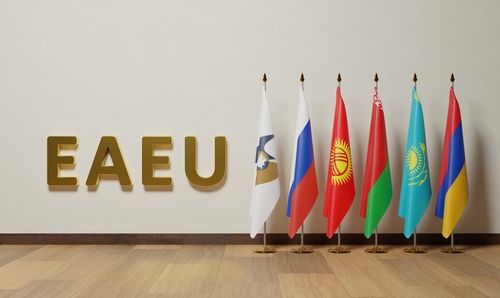
Established in 2015, the Eurasian Economic Union (EAEU) was created to boost economic cooperation within the central and northern Asia and Eastern Europe regions. The EAEU, composed of Russia, Armenia, Belarus, Kazakhstan, and Kyrgyzstan, aims to raise the standard of living for its members through increased economic cooperation. However, unlike the European Union (EU), it does not have one common currency.
The formation of the EAEU was, in part, a response to the increasing economic and political impact of the EU and other Western trade agreements. It ensures free movement of goods, services, labor, and capital among its members. Additionally, it provides for common policies in areas like transport, industry, agriculture, energy, foreign trade, and investment.
Governance within the EAEU is carried out by The Supreme Eurasian Economic Council and the Eurasian Economic Commission, serving as the governing and executive bodies, respectively. There is also a judicial division known as the Court of the EAEU.
Following the dissolution of the Soviet Union in 1991, many of the former Soviet republics were thrust into economic instability. Despite the collapse of economic relations that this brought about, the historical ties between Russia and these countries, known as the “Near Abroad,” were still significant. This recognition ignited various discussions on economic cooperation within the region. These talks eventually led to the creation of a detailed plan for a Eurasian Union and a series of treaties that fortified economic relations between the member countries.
In May 2014, the EAEU was officially established by founding member states Belarus, Kazakhstan, and Russia. Armenia and Kyrgyzstan later joined the union in 2014 and 2015, respectively. The goal of the Russian President, Vladimir Putin, is to extend the EAEU to all post-Soviet states, excluding Lithuania, Latvia, and Estonia who are already members of the European Union.
Countries like Tajikistan, Uzbekistan, Georgia, Moldova, Ukraine, and Turkey have been offered EAEU membership. However, the EU has also expressed interest in these countries. Consequently, the EAEU and the EU are currently in an economic competition over the integration of Eastern Europe.